Information
Retrieval-Augmented Generation for SMEs in 2026: A Practical Architecture Guide
A practical 2026 guide to retrieval-augmented generation for small and medium enterprises: what to deploy first, when GraphRAG or agentic retrieval earns its cost, and how to keep RAG accurate and affordable.
Retrieval-Augmented Generation for SMEs in 2026: A Practical Architecture Guide
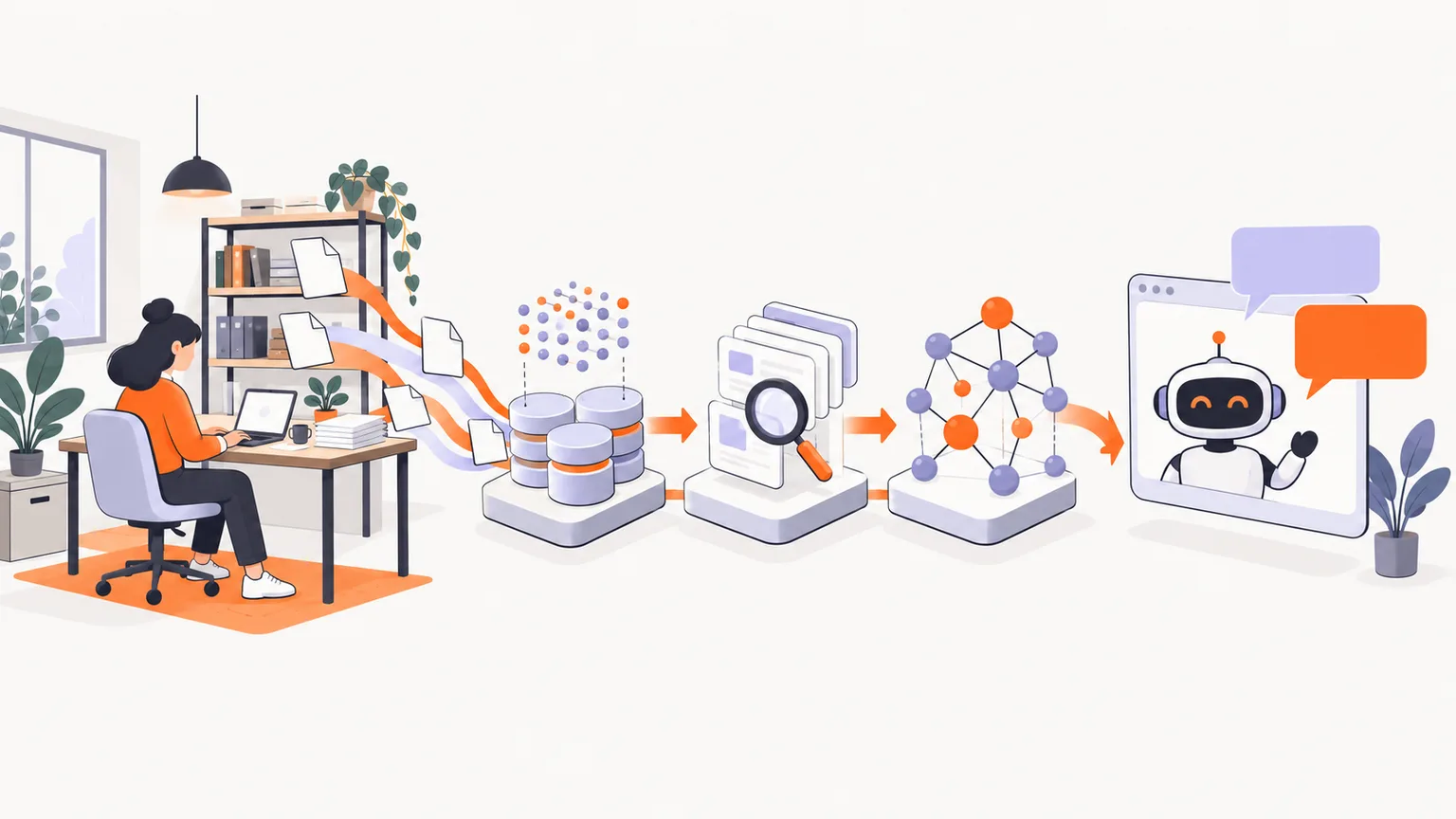
RAG for small business starts with a practical problem: employees need reliable answers from scattered manuals, policies, tickets, and project records. A language model can draft an answer, but it does not automatically know which company document is current or which customer information the employee may access. Retrieval-augmented generation connects the question to relevant evidence before the model responds.
In 2026, the useful choices extend beyond embedding documents and retrieving similar paragraphs. Hybrid search reranking handles both business terminology and semantic meaning. GraphRAG connects related entities. Agentic RAG lets a model choose successive searches and document reads. These methods solve different retrieval failures; adding all of them can make a small deployment harder to operate without improving its answers.
This guide explains retrieval augmented generation in 2026 through an illustrative 40-person company with 5,000 documents and 20,000 monthly questions. The architecture recommendations and budgets are planning examples, not vendor quotations or measured customer results. Model connectivity can follow the Omega Plus API documentation, while evidence selection, permissions, and evaluation remain application responsibilities.
How RAG works for a small business
Separate learning from looking things up
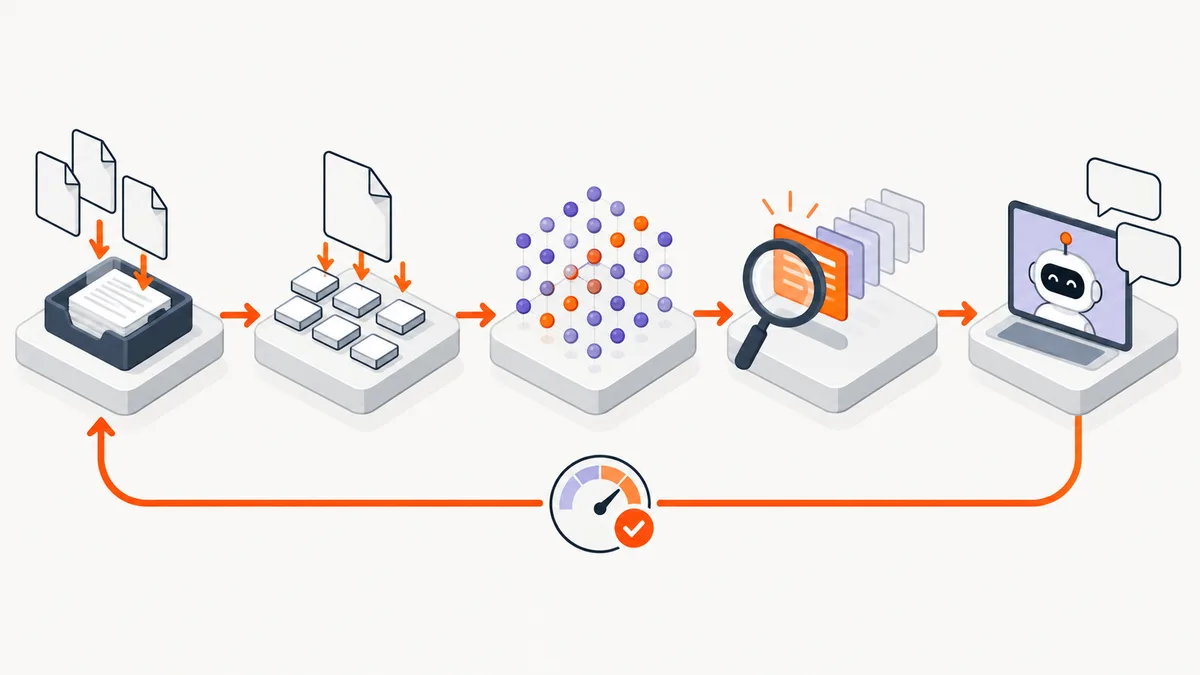
RAG retrieves information at inference time: when someone asks a question. An ingestion job extracts document text, divides it into useful passages, creates searchable representations, and records provenance. The question then drives a search. Selected passages enter the model's context alongside instructions, and the model produces an answer with references to supporting evidence.
Embeddings represent text as numerical vectors. Similar vectors often indicate related meaning, allowing a search for “annual leave” to find a paragraph about “vacation entitlement.” However, similarity does not establish truth, freshness, or authorization. An obsolete policy can be highly similar to the question. Retrieval needs metadata filters and authoritative sources as well as an embedding model.
Choose a bounded business outcome
A useful first project answers support questions from approved product manuals. Define success as fewer escalations, correct citations, and shorter handling time. Avoid beginning with every shared drive and mailbox. RAG supplies evidence; it does not automatically reconcile conflicting policies, validate arithmetic, or guarantee factual answers. Inventory totals should come from a database query, with RAG explaining the result if needed.
A minimum viable RAG architecture
Keep ingestion and answering separate
For a small team, a service with background ingestion and a relational database is often enough. Keep original files in object storage. Store chunks with document ID, source location, section heading, content hash, effective date, owner, tenant, and access rules. Version changes and deletions must update the searchable index; otherwise yesterday's withdrawn instructions remain available today.
Start by testing chunks around 400–800 tokens, preserving headings and a small amount of overlap where sections continue. This is a tuning range, not a universal optimum. Tables need column labels and units attached to their rows. Scanned PDFs need OCR checks. A perfect retriever cannot recover a warranty exception lost during extraction.
Use the infrastructure your team understands
PostgreSQL with pgvector combines application records, permissions, and vector search in one system. Its documentation describes combining vectors with PostgreSQL full-text search for hybrid retrieval. PostgreSQL's built-in text ranking is not automatically BM25. See the pgvector search and indexing documentation before choosing an index strategy.
Qdrant supports hybrid and multistage queries through its Query API. Elasticsearch combines lexical and vector retrieval using hybrid search. Either can suit an existing deployment. Introducing another database requires backups, monitoring, and ownership. Keep model access behind a replaceable adapter informed by the Omega Plus integration reference.
Size the index from chunks rather than files. If 5,000 documents produce 50,000 chunks, 1,536-dimensional vectors stored as four-byte values occupy about 307 MB before index structures, text, and metadata. This arithmetic explains why a modest corpus may fit existing infrastructure, but it is not a total memory estimate. Measure database size and query latency with realistic permission filters before selecting a hosting tier.
When simpler vector RAG is enough
Look at the question distribution
Vector RAG is a reasonable baseline when most questions seek a fact or procedure contained in one coherent section. Examples include resetting a device, explaining a service tier, or locating an onboarding checklist. A clean corpus of 500–5,000 documents can work well without graph extraction or an agent loop, although document count alone does not determine suitability.
Retrieve perhaps 10 candidates and send the best 3–5 passages, subject to evaluation. If ordinary questions consistently retrieve supporting evidence and answers meet acceptance criteria, keep the system simple. Exact identifiers may justify lexical search; that still does not require a knowledge graph.
Upgrade from diagnosed failures
Inspect missed answers before changing architecture. Missing text needs ingestion repair. Wrong product versions need filters. Similar but irrelevant passages need better ranking. Cross-document dependencies may need graph traversal or multiple searches. The Omega Plus Journal's engineering guides can support implementation decisions, but your own failed queries should decide which feature comes next.
Hybrid search and reranking: the practical next step
Combine exact terms with semantic meaning
Employees mix intent with identifiers: “Does SKU AX-441 qualify for replacement after water damage?” Semantic search recognizes the warranty topic, while lexical search preserves the SKU. Run both branches with the same permission and version filters. Start with 20–30 candidates per branch, deduplicate their union, and merge rankings using reciprocal rank fusion, or RRF.
RRF combines positions rather than directly adding incomparable vector and keyword scores. Its smoothing constant and candidate limits still need validation. This approach improves coverage when the two retrievers find complementary evidence; it cannot manufacture an answer absent from the corpus. Preserve the original query when rewriting so product numbers and quoted terms survive.
Rerank a shortlist before generation
A reranker evaluates each query–passage pair more closely than the initial retrieval stage. Rerank 30–50 unique candidates, then assemble roughly 5–8 passages within a context budget. These are starting settings. Cohere's Rerank documentation describes an API that accepts a query and documents and returns relevance ordering; its current catalog includes Rerank 4 variants.
Measure the quality gain against added latency, request costs, and data processing requirements. A reranker score is not a calibrated probability that the final answer is correct. Skip reranking when an exact, authoritative lookup already succeeds. For implementation work, Omega Code's development workspace provides a place to build and inspect the retrieval integration.
GraphRAG vs vector RAG: relationships change the task
Use graphs for questions about connections
Vector retrieval finds related passages; knowledge graph RAG can follow explicit relationships between customers, contracts, suppliers, products, and incidents. Consider “Which customers depend on components supplied by the factory affected by incident I-17?” The relevant chain may span incident reports, bills of materials, and customer orders. A graph can make that chain queryable instead of hoping one passage describes it.
Neo4j's GraphRAG package offers vector, hybrid, and graph-enriched retrieval patterns. Its GraphRAG user guide documents configurable retrievers and generation. For an SME, start with trustworthy relationships imported from existing records. Store source IDs and effective dates on edges. LLM-extracted relationships need validation because an incorrect connection can produce a persuasive but false explanation.
Distinguish named research systems
Microsoft GraphRAG extracts entities and relationships, organizes graph communities, and creates community summaries. Its global search addresses broad corpus questions; local search focuses on entities; DRIFT combines local exploration with community context. Basic search remains available for vector retrieval. This is a particular architecture, rather than a synonym for every graph-assisted search.
HippoRAG2, introduced in 2025, develops graph-based associative retrieval using Personalized PageRank, passage integration, and online LLM processing. It is relevant to 2026 architecture choices, but should not be described as a new 2026 paper. Neither its benchmark gains nor Microsoft's examples guarantee improvements on a company's own documents.
Route selectively to control complexity
The February 2026 preprint Use Graph When It Needs proposes EA-GraphRAG, routing questions between dense and graph retrieval according to estimated complexity. Its reported benchmark results support testing selective graph use; they do not establish a universal business return. A practical SME inference is to retain ordinary retrieval for routine questions and trial graph retrieval on a labeled dependency-question subset.
Agentic RAG with hierarchical retrieval interfaces
Let the model choose the next evidence request
Agentic RAG makes retrieval iterative. The model searches, inspects evidence, identifies a gap, and chooses another search or read before answering. A fixed pipeline might retrieve once; an agent investigating a disputed installation date can locate a ticket, read its referenced project report, and check the acceptance record. Additional steps are useful when the evidence path depends on intermediate findings.
A-RAG's February 2026 paper exposes three hierarchical retrieval tools: keyword search, semantic search, and chunk read. The agent chooses information at different granularities. The authors report improvements on open-domain question-answering benchmarks with comparable or lower retrieved tokens. Retrieved tokens are only part of total cost; reasoning, repeated inference, and tool latency still matter.
Expose small results, then deeper reads
An SME can adopt the interface idea without reproducing the research framework. Search tools return titles, snippets, document IDs, and section locations. A separate read tool returns a bounded passage with provenance. Optional document outlines help the model navigate longer files. Every operation enforces authenticated permissions, including reads after an apparently authorized search result.
Start with a maximum of three retrieval rounds, six tool calls, a 12,000-token evidence allowance, and a 15-second interactive deadline. These are application limits to test, not A-RAG specifications. Stop when evidence supports the answer, the budget expires, or a required source is unavailable. Return a cited partial answer or request clarification. The Omega Plus downloads page helps teams choose their development client while maintaining these controls in the application.
Context engineering: make evidence usable
Design a finite evidence packet
Context engineering manages everything the model sees: instructions, conversation state, tool definitions, retrieved passages, and output requirements. A larger context window does not remove the need to select evidence. Duplicate passages consume budget; conflicting versions can confuse generation; summaries can accidentally remove exceptions that determine the answer.
Begin with an explicit 4,000–8,000-token evidence budget for ordinary questions. Deduplicate overlapping chunks, retain dates and section titles, and group related passages. Attach stable citation IDs to the text actually supplied. Preserve exact numbers, units, conditions, and negation during compression. If a summary suggests a critical clause, read the original clause before relying on it.
Specify uncertainty and citation behavior
Tell the model to answer from supplied evidence, identify unsupported details, and cite each material claim. Separate retrieved content from governing instructions. Require conflicting sources to be named with their dates. Validate that cited IDs exist; then sample whether each cited passage supports the attached statement. Citation formatting alone does not prove grounding.
Apply the same discipline to conversation history: keep the user's constraints and unresolved question, then discard repeated tool output. Our guide to reducing CLI agent token usage in 2026 explains why context maintenance also affects running costs.
Evaluation: measure retrieval and answers separately
Build a small, representative test set
Collect 120 questions: 60 routine lookups, 20 identifier-heavy searches, 20 cross-document questions, and 20 unanswerable or access-restricted requests. Have subject experts label supporting passages, acceptable answers, and required abstentions. Keep a held-out portion for release decisions so repeated tuning does not turn the entire collection into training material.
For retrieval, measure whether required evidence appears in the top results. Hit rate asks whether any relevant item was found; recall asks what fraction of labeled relevant items was recovered. Multi-hop questions need a coverage check for every required evidence link. Evaluate ranking after reranking and evidence coverage after context assembly, since good passages can disappear between those stages.
Use release gates tied to business risk
Assess answer correctness, claim support, completeness, citation accuracy, and abstention behavior. Illustrative pilot gates might require at least 90% acceptable answers on routine questions and zero observed permission leaks in adversarial tests. Neither threshold proves future safety. Review every restricted-data failure, and record results by question class so aggregate accuracy cannot hide poor identifier handling.
Track p50 and p95 latency, token counts, tool rounds, retries, and cost per accepted answer. Use automated judges to triage large samples, with human calibration and review of consequential cases. The Galileo-origin enterprise RAG architecture guide, now hosted by Splunk, distinguishes failure points across retrieval, context consolidation, and generation. That separation helps locate the stage requiring repair.
Change one component at a time. Compare vector retrieval with hybrid retrieval, then add reranking, keeping the corpus snapshot and answer model fixed. Trial graphs and agent loops only on their intended question classes. Record actual wins, regressions, and reviewer disagreement rather than a single score. With 120 questions, one changed outcome moves an aggregate rate by about 0.83 percentage points; small differences should prompt further sampling rather than confident claims of superiority.
RAG cost optimization with an explicit SME budget
Calculate the request before choosing the stack
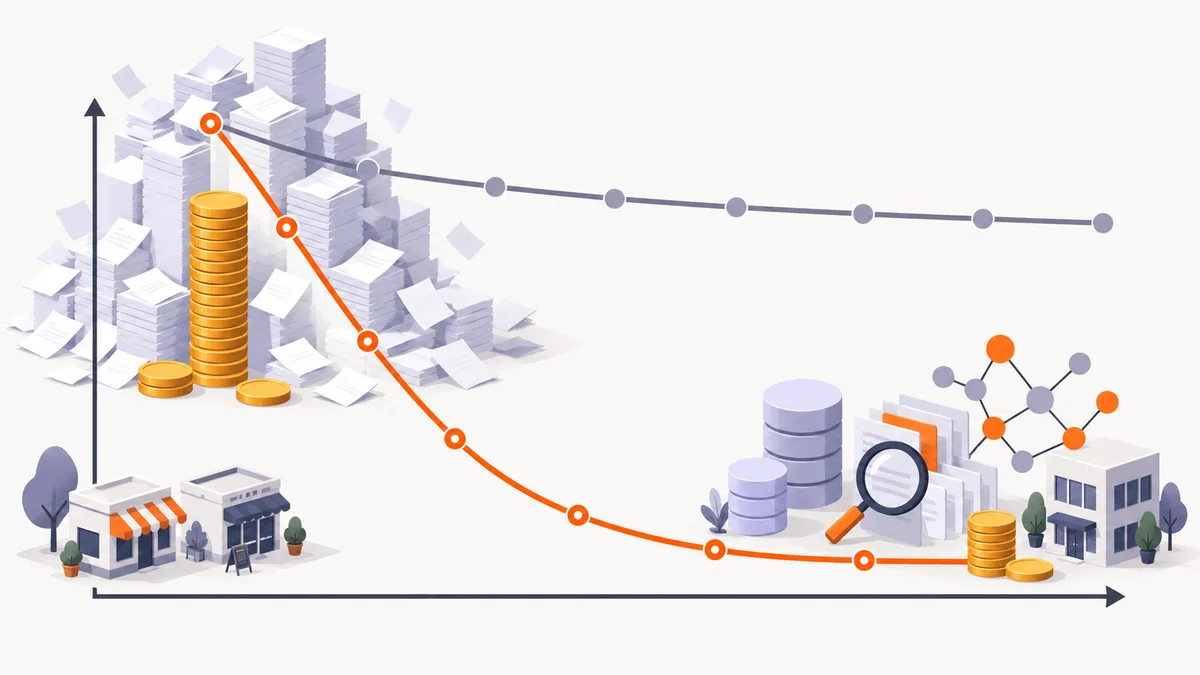
Assume 20,000 questions per month, averaging 3,500 total input tokens and 500 generated output tokens. At illustrative rates of $1 per million input tokens and $4 per million output tokens, generation costs $70 + $40 = $110 monthly, or $0.0055 per answer. These assumed rates are not current prices for a named model or an Omega Plus quotation.
Add retrieval infrastructure and operational services. The following scenario allocates a modest budget for hosted components; actual costs depend on region, availability requirements, document changes, reranker billing, and retained logs. Embedding spend includes incremental indexing and query embeddings. Full-corpus rebuilds, OCR, network transfer, taxes, and staff time require separate allowances.
| Monthly component | Illustrative allowance | What changes the cost |
|---|---|---|
| Answer generation | $110 | Context length, output length, model rates |
| Database, application, storage | $60–$180 | Memory, backups, redundancy, traffic |
| Embedding operations | $10–$30 | Changed documents and query volume |
| Reranking | $20–$60 | Requests and candidate lengths |
| Monitoring and evaluation services | $10–$40 | Trace retention and judge calls |
| Total operating allowance | $210–$420 | Excludes labor and initial implementation |
Budget for graph builds and agent loops
For an illustrative 10-million-token corpus, graph extraction using 10 million input and 2 million output tokens at the same assumed rates costs $18 in generation alone. Repeated extraction passes, community summaries, retries, and a dedicated graph service add costs. The larger burden may be validating entities and maintaining relationships; a small invoice does not make a graph operationally cheap.
If an agent makes four generation calls per question at the example's same average token counts, generation rises from $110 to $440 monthly before extra retrieval. Real loops vary in context and reasoning volume. Route only the difficult 10% of questions through that four-call path and generation becomes approximately $143: $99 for ordinary requests plus $44 for agent requests.
Optimize cost per successful task
Use content hashes to avoid re-embedding unchanged documents. Cache answers only with tenant, authorization scope, source versions, and model configuration in the key. Invalidate caches after updates and permission changes. Cap retries and tool rounds. Track accepted answers per dollar alongside support time saved. The analysis of the 2026 AI investment and adaptation gap explains why adoption and workflow fit matter when judging spending.
Permissions and data lifecycle are core architecture
Enforce access before exposing evidence
Apply tenant and document access filters before results enter model context or an external reranker. Repeat authorization on direct document reads and graph traversal. Shared community summaries require access-aware construction or conservative isolation, because a summary can reveal details from restricted source documents. Graph edges and cached answers need the same scrutiny as chunks.
Treat documents as untrusted data: embedded instructions must not authorize tool calls or change system policy. A read-only RAG assistant should not inherit payment or account-administration tools. Log source IDs and decisions without unnecessarily retaining private document text. Assign someone to handle ingestion failures, expired policies, revoked access, deletion propagation, and rollback.
Test the lifecycle with a concrete drill: publish a revised policy, verify its retrieval, revoke a tester's access, and confirm that search, direct reads, and cached answers all respect the change. Repeat after deleting the document. Establish a freshness target, such as processing approved updates within one hour, and alert when ingestion falls behind.
What a small team can realistically deploy
Ship one workflow over four weeks
An illustrative four-week pilot can fit one engineer working with a support lead and a part-time security reviewer, provided the sources and permissions are already accessible. This is a scheduling assumption; connector complexity and document cleanup can extend it. A managed database usually reduces maintenance compared with introducing several self-hosted services at once.
- Week one: choose one support workflow, approve sources, map permissions, and label evaluation questions.
- Week two: implement ingestion, vector retrieval, cited answers, and deletion handling.
- Week three: compare lexical fusion and reranking against the baseline; fix extraction and version errors.
- Week four: pilot with 5–10 employees, inspect failures, enforce budget limits, and establish an owner.
Add graph retrieval when relationship questions remain valuable and poorly served. Add agentic retrieval when successive searches improve a measured task enough to justify latency and complexity. Forrester's discussion of evolving RAG architectures and best practices provides broader context. Sustainable SME AI adoption depends on an owned workflow, maintained evidence, and measurable benefits.
Frequently asked questions
What is RAG for small business?
It is an application pattern that retrieves relevant company information before a language model answers. A small business can use it for support manuals, onboarding policies, or project knowledge. The essential components are maintained sources, permission-aware search, bounded context, citations, and evaluation.
When is vector RAG sufficient?
Vector RAG is sufficient when representative questions usually have answers in one coherent passage and evaluation shows reliable evidence retrieval. Clean extraction and metadata filters matter more than document count. Add lexical search when identifiers cause misses; add further complexity only for diagnosed failures.
How should an SME compare GraphRAG vs vector RAG?
Compare them on the same labeled questions, sources, answer model, and spending limits. Separate simple lookups from dependency and cross-document questions. GraphRAG can help with relationships, but extraction errors and maintenance may offset gains. Retain vector retrieval wherever it meets your acceptance criteria.
Does agentic RAG always cost more?
No. Selective searches can reduce retrieved text, but additional reasoning and generation calls can increase total charges and latency. A-RAG's token findings concern its evaluated setting, not every business workload. Measure complete request traces, impose stopping rules, and compare cost per accepted answer.
How much should a small RAG pilot budget?
This guide's explicit 20,000-question scenario allows $210–$420 monthly for operating services, excluding staff, implementation, and initial processing. It is an illustrative budget, not a quote. Smaller usage may still incur infrastructure minimums; graph maintenance, redundancy, and larger models can raise spending substantially.
Can RAG eliminate hallucinations and stale answers?
No. Retrieval improves access to evidence but does not guarantee correct interpretation. Stale indexes, conflicting policies, missing passages, and unsupported synthesis still cause errors. Maintain versioned sources, test citations and abstention, propagate deletions, and route consequential or ambiguous decisions to a qualified person.
This guide was produced by the Omega Plus Media Team. Sources were checked on October 2, 2026; research findings and illustrative budgets are identified separately.
Sources and further reading
- A-RAG: Scaling Agentic Retrieval-Augmented Generation via Hierarchical Retrieval Interfaces — February 2026 preprint on adaptive search and chunk reads.
- Use Graph When It Needs: Efficiently and Adaptively Integrating Retrieval-Augmented Generation with Graphs — February 2026 preprint on selective retrieval routing.
- Galileo-origin enterprise RAG architecture guide, now at Splunk — pipeline design and failure diagnosis.
- Forrester: evolving RAG architectures and best practices — enterprise architecture considerations.
- pgvector documentation — PostgreSQL vector indexes, filtering, and hybrid search.
- Neo4j GraphRAG Python user guide — configurable retrieval and generation.
- Microsoft GraphRAG documentation — graph indexing, community summaries, and query modes.
- From RAG to Memory: HippoRAG2 — 2025 research on associative retrieval and passage integration.