Discussion
AI Agents vs AI Workflows: What Businesses Should Automate in 2026
A practical discussion of where deterministic workflows outperform agents, where adaptive systems create value, and how businesses can automate without losing control.
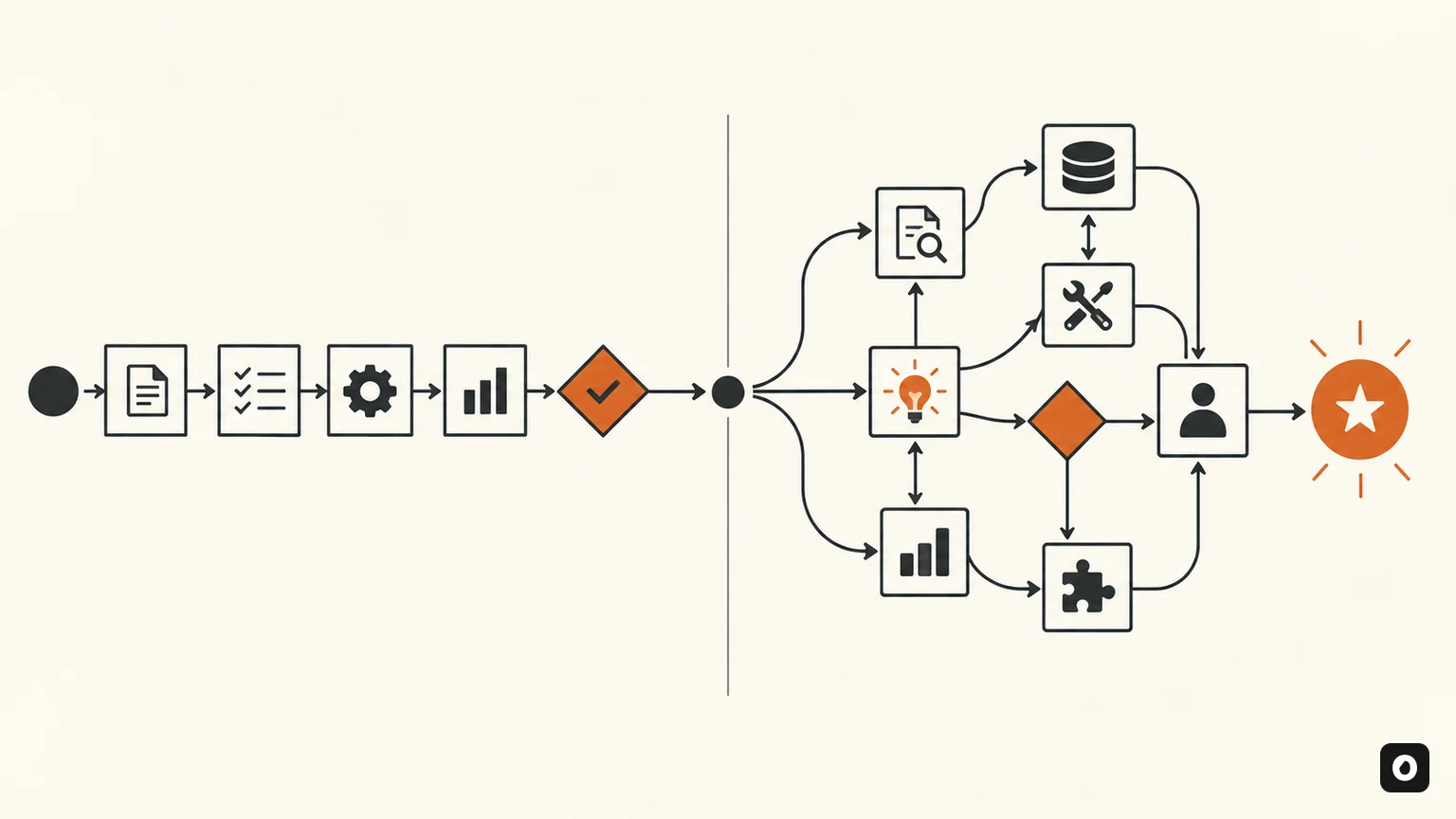
AI agents are becoming a serious operating model for business software, but not every process should be agentic. This discussion separates agents from workflows, examines the trade-offs that matter in production, and provides a practical framework for deciding what to automate in 2026.
The debate is not agents versus automation
The loudest version of the AI conversation suggests that autonomous agents will replace conventional workflows. That framing is attractive because it creates a clean before-and-after story, but it is technically unhelpful. Businesses do not choose between “old automation” and “intelligence” once. They design systems made of deterministic steps, model calls, tools, approvals, and human judgment. The important question is where each kind of control belongs. A payroll transfer and a first draft of a market brief should not share the same autonomy policy.
Anthropic draws a useful architectural distinction: workflows orchestrate models and tools through predefined code paths, while agents dynamically direct their own process and tool use. Both are agentic systems in the broader sense, but they produce different operational behavior. A workflow expresses what should happen next in code. An agent chooses what should happen next based on its goal and current evidence. That choice buys adaptability at the cost of predictability, latency, evaluation complexity, and sometimes money.
In 2026, the winning pattern is not maximum autonomy. It is selective autonomy inside a controlled product. Teams can use an inference layer such as the Omega Plus API for model access, deterministic software for policy and accounting, and agent loops only where the problem genuinely requires interpretation. The design objective is dependable completion, not an impressive demo.
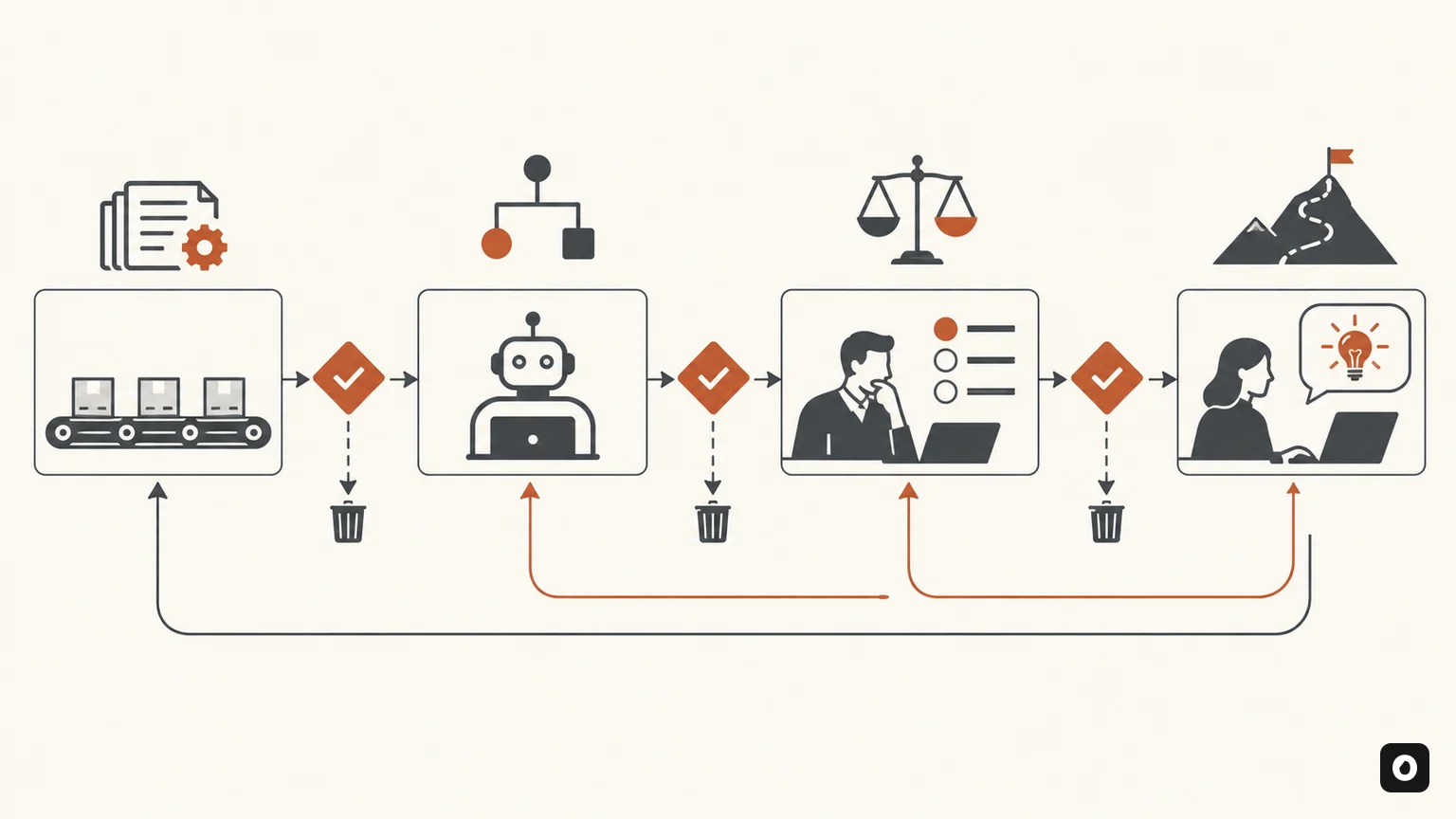
Assistant, workflow, agent, and multi-agent system
An AI assistant responds to a user and may produce content, analysis, or recommendations. It can be extremely capable without controlling an external process. A workflow combines one or more steps in a predefined sequence: classify an email, extract fields, validate them, draft a response, and send it for approval. A router may choose among several fixed branches, but the possible branches and transitions remain designed in advance.
An agent receives an objective, observes its environment, selects tools, evaluates intermediate results, and adjusts its plan until it reaches a stop condition. It may decide to search again, inspect a file, ask a clarifying question, or abandon an approach. A multi-agent system distributes work among specialized agents, often with a coordinator. More agents do not automatically produce more intelligence. They also create more handoffs, duplicated context, conflicting conclusions, and harder debugging.
These categories form a spectrum rather than four isolated boxes. A fixed workflow may contain one agentic research step. An agent may execute deterministic sub-workflows for payments or notifications. A chat interface such as the Omega Chat workspace can offer conversational assistance while separate services enforce business rules. Good architecture names these boundaries so that teams know which behavior is guaranteed and which is inferred.
Where deterministic workflows still win
Use a workflow when inputs are structured, valid outcomes are known, and the organization can describe the process as rules. Invoice totals, entitlement checks, identity verification gates, approval routing, data retention, and ledger updates are classic examples. A model may extract information or explain an exception, but code should enforce arithmetic and policy. Deterministic execution is easier to test exhaustively, reproduce during an incident, and audit for regulators or customers.
Workflows also win when mistakes are expensive and difficult to reverse. Sending a refund, deleting a record, changing access, or publishing a legal notice deserves an explicit transaction boundary. An agent can prepare the operation, but a workflow should validate constraints and require the appropriate approval. This is not a lack of ambition; it is a recognition that language-model confidence is not authorization.
Finally, workflows are efficient at scale. A known path avoids repeated planning tokens and unnecessary tool calls. Latency is bounded by a small number of steps. Caches are easier to use, and capacity planning becomes credible. If a process handles thousands of similar requests each hour, a workflow with a model at one ambiguous step often delivers better economics than a general agent reconsidering the entire task every time.
Where agents earn their complexity
Agents become useful when the route to the outcome cannot be enumerated in advance. Repository maintenance is a good example: the right files, tests, and fixes depend on what the agent discovers. Research across inconsistent sources is another. Incident investigation, vendor comparison, migration planning, and support diagnosis often require branching inquiry, tool selection, and revision. The value comes from adapting the process to evidence rather than following a universal checklist.
An agent is also justified when the environment changes during the task. A coding agent may run tests, observe a failure, inspect an unfamiliar module, and revise its plan. A terminal product such as Omega Code can expose plan and approval modes so the user retains control while the execution path evolves. The agent should still have bounded tools and a clear definition of done; adaptability is not permission to operate indefinitely.
Another strong case is synthesis. A human analyst may know the destination but not which evidence will matter until research begins. The agent can search, compare, challenge an early hypothesis, and assemble a reviewable result. However, the final output should preserve sources and uncertainty. An agent that produces a polished document without traceable evidence may save typing while increasing decision risk.
A four-part decision framework
First, assess variability. How often do cases require a route that designers could not specify? If ninety-nine percent follow the same path, build the path and handle exceptions separately. If the work is genuinely investigative, a bounded agent may fit. Second, assess consequence. Ask what happens if the system chooses the wrong tool, target, or timing. High-consequence work requires deterministic constraints and usually a human approval gate.
Third, assess reversibility. Drafting, searching, categorizing, and creating a preview are easier to delegate because mistakes can be inspected or discarded. Sending, publishing, transferring, deleting, and granting access are harder to reverse. Fourth, assess verifiability. A coding change can be checked with tests; a data transformation can be reconciled; a research claim can be checked against citations. If success cannot be measured, autonomy will be difficult to improve safely.
These axes lead to a practical policy. Stable, low-risk, reversible, verifiable work belongs in workflows. Variable but reversible work is a good candidate for agents. Variable, high-risk work can use agents for preparation but should reserve execution for controlled code and people. Unverifiable high-risk work should not be autonomously automated. The same company may use all four patterns, even inside one customer journey.
Human in the loop should mean a real control
Many products claim human oversight because a person can theoretically stop an agent. That is not enough. A useful approval step appears before the consequential action, states exactly what will happen, identifies the target, explains why the action is proposed, and offers a safe way to change or reject it. The system must not interpret silence or an unrelated message as consent. Approval events should be recorded independently from model text.
Review should match the reviewer’s expertise. A finance manager needs totals, exceptions, evidence, and policy context—not a transcript of every reasoning step. A developer reviewing a patch needs the diff, test outcome, and residual risk. A support lead reviewing a proposed message needs the source ticket and relevant account facts. Interface design turns oversight from a ceremonial button into an effective safety mechanism.
Humans should also be able to define standing boundaries. A team might permit an agent to label and draft responses but never send them, or to change files inside a repository but never alter deployment credentials. This is where a dedicated policy layer such as the in-development Omega Secure can become valuable: permissions and privacy constraints should be explicit system behavior rather than prose hidden in a prompt.
Tools and data determine agent quality
A powerful model with poor tools behaves like an expert working through a keyhole. Tool names, schemas, results, and error messages determine what the agent can understand. Operations should be narrow, typed, and aligned with real business concepts. A customer lookup should return the fields required for the next decision, not an unfiltered database row. A state-changing tool should support previews and idempotency. Errors should distinguish invalid input from unavailable dependencies and policy rejection.
Data quality is equally important. Agents cannot reliably reconcile stale catalogs, contradictory policies, missing ownership, and documents without dates. Retrieval needs permissions, provenance, freshness, ranking, and evaluation. The planned Omega Bhaskar retrieval framework is intended to help build grounded knowledge experiences, but any implementation still needs responsible source management. Retrieval is an engineering system, not a switch labeled “RAG.”
Keep the visible tool surface small. When an agent receives dozens or hundreds of similar tools, selection gets less reliable and prompt cost rises. Use progressive discovery, task-specific bundles, or a router that presents only relevant operations. The user’s role and current context should further restrict what is available. Least privilege improves both security and decision quality.
Cost and latency are architectural properties
A workflow’s cost can often be estimated by counting its model calls and average input and output. An agent’s cost is a distribution because it may loop, retry, or gather more context. Measure cost per completed objective rather than cost per model call. A cheap call repeated twenty times may be more expensive than a stronger model completing the task in three. The Omega Plus model catalog gives developers multiple public model identities, but model selection is only one part of the economics.
Latency compounds in the same way. First-token speed matters in a conversation, while total completion time matters for an automated task. Parallel tool calls can reduce time when they are independent, but they also consume concurrency and may overload dependencies. Streaming improves perceived responsiveness but does not make an unfinished operation safe. Background tasks are preferable when the objective cannot fit an interactive window.
Set budgets for steps, loops, tokens, tool calls, elapsed time, and external spend. When a budget is reached, the agent should summarize progress, unresolved questions, and a safe next step. A bounded partial result is better than an invisible runaway process. Budget events are also valuable evaluation data: they reveal tasks that need better tools, clearer instructions, or a deterministic workflow.
Evaluate outcomes, not personality
Agent demos are often judged by whether the response sounds confident and natural. Production evaluation should ask whether the objective was completed correctly, within policy, using acceptable resources. Create a dataset of representative tasks with expected evidence, allowed actions, prohibited actions, and measurable success. Include ambiguous inputs, missing data, dependency failures, adversarial content, and cases that should be escalated.
Use layered metrics. At the model level, measure instruction following and structured-output validity. At the tool level, measure selection accuracy, argument validity, error recovery, and unnecessary calls. At the workflow level, measure completion, latency, cost, and handoff quality. At the business level, measure the operational outcome: resolution time, defect rate, conversion, or analyst hours saved. A high tool-call success rate means little if customers still cannot finish the job.
Replay tests are important but not sufficient because models and external systems change. Run continuous samples, monitor drift, and compare releases against a fixed baseline. Human review should label specific failure modes rather than an overall “good” or “bad.” The 2026 discussion around trustworthy agents increasingly emphasizes measurement, transparency, and calibrated reliance rather than blanket trust.
Failure modes businesses underestimate
The first is silent partial completion. An agent performs four of five steps, then presents the result as complete. Require explicit completion criteria and verify external state. The second is retry amplification. A timeout causes repeated actions, duplicated records, or a burst against an upstream limit. Use idempotency keys and bounded retry policy. The third is context contamination, where untrusted data is treated as instruction. Separate authority from evidence and constrain tools during untrusted retrieval.
The fourth is privilege accumulation. Teams add tools over time and never remove access, leaving every future task with unnecessary authority. Review scopes and build task-specific bundles. The fifth is evaluation blindness: a team tracks HTTP success but not whether the result was correct. The sixth is handoff failure. When an agent escalates, it gives the human a transcript instead of a concise state, evidence, attempts, and required decision.
The seventh is model-identity coupling. Product logic assumes a particular vendor’s response quirks, tool format, or model name. A stable application contract and a platform such as Omega Plus can reduce that coupling, but developers must still test behavior across the models they expose. Portability is earned through normalization and evaluations, not claimed because two endpoints both accept JSON.
Examples across business functions
In customer support, a workflow can identify the account, classify the issue, retrieve policy, and produce a draft. An agent may investigate unusual technical cases across logs and documentation. Refund approval remains deterministic. In finance, workflows handle reconciliation and exception flags, while an agent can explain anomalies and prepare a review package. The ledger remains code-owned. In sales operations, an agent can research a prospect and draft outreach, but consent, suppression lists, and sending limits remain enforced by systems.
In software development, agents are particularly useful because repositories provide executable feedback. They can inspect code, propose a plan, edit within scope, and run tests. Release permissions and secrets should stay outside the agent’s default authority. In knowledge work, an agent can compare sources and build a cited brief, while a human decides which uncertainty is acceptable. In voice experiences, an agent may prepare content while a controlled Omega Voice 1 endpoint renders approved text; this keeps generation and delivery responsibilities distinct.
Across these examples, hybrid architecture repeats: deterministic intake, bounded reasoning, typed tools, explicit approval, verified execution, and an auditable result. The agent is a component, not the organization chart.
A sensible adoption roadmap
Begin with assistance. Identify a repeated, time-consuming task and let the model draft or summarize while a person executes. Capture corrections. Next, automate a stable workflow with clear rules and measurements. Introduce an agent only for the variable segment, and keep its initial tools read-only. Add previews, approval, and rollback before granting write authority.
Run the system in shadow mode against real cases without affecting external state. Compare its decisions with human outcomes. Then release to a small group, monitor every completion, and publish known limitations. Expand based on evidence rather than enthusiasm. Teams that cannot explain how they will detect a harmful action are not ready to automate that action.
Infrastructure should evolve alongside autonomy. Centralize identity, secrets, logs, budgets, evaluations, and incident response. Keep application interfaces separate from provider-specific behavior. If agent applications later require managed deployment, the in-development Omega Cloud represents the ecosystem’s intended deployment layer, but current teams should choose a hosting architecture that they can operate today.
The operating model matters as much as the model
Someone must own each automated process after launch. Product owners define acceptable outcomes, domain experts maintain the rules, engineering owns reliability, security reviews authority, and operations respond when behavior drifts. These responsibilities can sit with a small team, but they cannot be absent. An agent without an owner becomes a production dependency whose failures are discovered by customers.
Create a change process for prompts, tools, models, policies, and source data. A minor wording change can alter tool selection; a model update can affect structured output; a new document can introduce contradictory instructions. Version important configurations, test them against the evaluation set, and roll out gradually. Preserve enough telemetry to compare releases without retaining unnecessary customer content. The objective is controlled improvement, not frozen behavior.
Incident response should include an immediate way to reduce autonomy. Teams may disable a tool, require approval for every write, route work back to a deterministic workflow, or pause the agent entirely. Document those controls before they are needed. After an incident, trace the decision chain from input and retrieved evidence through tool calls to external state, then add a regression case. Learning from failures is only possible when the system is observable.
Questions leaders should ask before buying an agent platform
Ask how identity and tenant isolation work, where prompts and tool results are stored, whether data is used for training, and how retention can be configured. Ask which actions are idempotent, how approval is represented, how costs are bounded, and whether you can export logs and evaluations. Ask what happens during provider failure, how model changes are communicated, and whether you can keep critical workflows running without the agent.
Request evidence rather than adjectives. “Enterprise-ready” should translate into documented controls, recovery objectives, auditability, access management, and measured reliability. “Autonomous” should come with a clear description of scope, stop conditions, budgets, and escalation. “Private” should explain processing, subprocessors, encryption, and deletion. A platform may be valuable without solving every concern, but the buyer needs to understand which responsibilities remain with the organization.
Run a pilot on your own representative tasks. Include failure and refusal cases, not only polished demonstrations. Compare the agent with the current process on quality, cycle time, cost, supervision, and recovery effort. If the pilot cannot produce a shared definition of success, scaling it will multiply uncertainty rather than value.
Our position: controlled adaptability
AI agents are not a replacement for workflows. They are a way to handle uncertainty inside systems that still need workflows. The most credible products make autonomy visible and bounded. They allow the model to decide where judgment is useful, while code decides what must always be true. They give users a clear opportunity to approve consequential actions and a reliable way to recover.
This balance will matter more as enterprises shift from asking models for advice to asking systems to execute work. OpenAI’s 2026 enterprise analysis describes this movement from assistance toward execution and highlights context, tools, permissions, governance, and shared workflows. The lesson is not to hand every process to an agent. It is to turn effective individual practices into controlled, observable systems.
Businesses should automate the predictable parts first, use agents for genuine variability, and measure the outcome that matters. Every additional degree of freedom should have a reason, a budget, and a control. That is how agentic AI becomes durable infrastructure rather than an expensive experiment.
Frequently asked questions
Is a chatbot an AI agent?
Not necessarily. A chatbot that answers questions is an assistant. It becomes more agent-like when it chooses tools and dynamically directs a multi-step process toward a goal.
Are agents always more capable than workflows?
No. Agents are more adaptable, but a deterministic workflow is often more reliable, faster, cheaper, and easier to audit for a known process.
Should an agent be allowed to execute payments?
It can prepare and recommend a payment, but deterministic validation, authorization, idempotency, and often human approval should control execution.
How many agents should a system use?
Use the minimum architecture that meets the objective. A single agent with good tools is usually easier to evaluate than a multi-agent network. Add specialization only when evidence shows a benefit.
What is the best first enterprise use case?
Choose high-volume, reversible work with clear quality criteria, accessible evidence, and low consequence. Drafting, classification, research preparation, and internal knowledge retrieval are common starting points.